Paper Published on
the Democratic Backsliding Problem
January 18, 2025
After much perseverance, a paper was published on the topic of Democracy’s eternal vulnerability: Increasing resilience to disinformation by raising the two components of political truth literacy. This is a major research report, complete with five supplementary material files. More.
Thwink Opens a Site on Substack
March 19, 2025
While the Thwink.org website has proven to be an excellent home for analytical content, it lacks the ability to easily produce regular articles that readers can discuss. Thwink is thus behind the times. Serious readers want regular articles. Serious activists want to comment, discuss, and participate in what diagnostic and prescriptive content is trying to do.
What tipped us into opening a second site on Substack was what Donald Trump began doing once his second term began on January 20, 2025. He and his team began aggressively destroying American democracy and its economy (while simultaneously aiding Russia) at a rate so fast it's hard to keep up. For those who believe in democracy over tyranny, this is THE crisis of our time.
According, we have opened The Analytical Activist on Substack. Start on the About page. This will tell you where the site is going. Then be sure to read the inaugural article on:
The Most Successful Intelligence Operation in History:
How Russia Put a Spy at the Top of the World’s Sole Superpower
and Is Proceeding to Destroy It and Democracy
Preventing the Death of Democracy:
First a correct diagnosis, then the cure will work
January 1, 2024
Why are popular solutions to the democratic backsliding problem failing? Because of a faulty diagnosis. Accordingly, we show how to perform a correct diagnosis, which opens the door to cures that will work.

As we will show, conventional wisdom has made a rather serious error in step two of the process of root cause analysis, by performing step two intuitively instead of explicitly. Sidney Harris alludes to this type of error in his famous cartoon above. (Copyright by ScienceCartoonsPlus.com, reproduced with permission)
A GLOBAL EPIDEMIC of deadly backsliding from democracy to authoritarianism is underway, with no solution in sight. No nation is immune, not even the birthplace of modern democracy, America, where Donald Trump currently beats Joe Biden in presidential polls and plans to destroy democratic institutions once he enters the White House for the second time. The problem has grown so acute that Freedom House reports that after 17 straight years of democratic decline, 80% of the world’s population lives in non-democracies.
The severity of the problem has attracted countless solution strategies. The most common center on forms of “more of the truth,” such as the Washington Post’s fact checker and Timothy Snyder’s pronouncement that “To stave off authoritarianism in their countries… people must resist the temptation to believe what they’d like to believe and turn instead toward truth.” Protect Democracy’s authoritarian playbook allows journalists to spot the seven basic tactics authoritarians use and report the truth about them. Other solutions focus on building “a broad prodemocratic coalition” to prevent authoritarianism from taking root, as Levitsky and Ziblatt urge in How Democracies Die. Still others attempt to prove democracy is superior to autocracy, like The Democracy Advantage using systematic examination of the data. And so on.
But none of this has worked. Why? For the answer we turn to the planet’s top problem-solving experts: the most successful businesses in the world.
What problem-solving tool do the world’s top three management strategy consultancies (McKinsey, Bain, and BCG) use to solve their client’s toughest causal problems? Root cause analysis in the form of MECE Issue Trees. What tool do 100% of aerospace, motor vehicle, electronics, and pharmaceutical companies in the Fortune 500 and 82% of all companies in the Fortune 100 use for quality control? Root cause analysis in the form of Six Sigma. The pattern is so strong it’s hard to find a large successful company that doesn’t use one or more explicit forms of root causes analysis.
(The article continues on this page.)
The Democracy in Crisis Film Series
As numerous people have observed, Democracy Is In Crisis. In more and more countries we see democracy no longer working for the common good, but backsliding to authoritarianism.
If you want to get the big picture of what Thwink.org is trying to do, these three films are the place to start. It's all here.
Why is this?
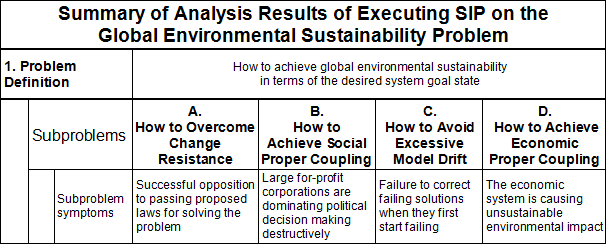
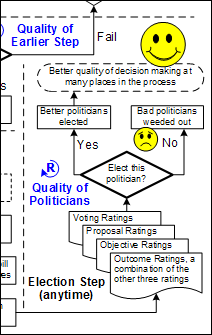
We don't have all the answers, but we suspect we have some. The rise of authoritarians fits right in the Thwink.org analysis of the sustainability problem. The analysis went so deep it found four main root causes. (This is a more detailed analysis than the one above, which found one main root cause.) It also found a feedback loop structure that explains WHY Trump and other authoritarians have been able to get elected and HOW that can be prevented from happening again, IF the root causes are resolved.
The first film is shown below. Try to watch it with good speakers or headphones because the music score plays a major part in the production. For the rest of the films see The Democracy in Crisis Film Series.