Systems Thinking
Contents
Event Oriented Thinkers and System Thinkers
The Key Concepts of Systems Thinking
Definition
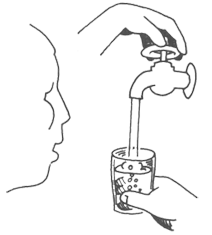
Lack of systems thinking produces a mental model based mostly on what you can physically see. This tends to give a shallow understanding of the way a system works. For example, when pouring a glass of water we usually think only in terms of turning on the faucet until the glass is full, and then turning it off.
Here's a definition from Barry Richmond, who coined the term in 1987: 1
Systems Thinking is the art and science of making reliable inferences about behavior by developing an increasingly deep understanding of underlying structure.
Cultivating this "art and science" leads to routine use of correct mental models that see the world as a complex system whose behavior is controlled by its dynamic structure, which is the way its feedback loops interact to drive the system's behavior. The term systems thinking is preferred to holistic or whole systems, which have looser and more intuitive meanings, and emphasize understanding the whole rather than the dynamic structure of the system.
Systems thinking is not stepping back to look at the whole, the big picture, or a higher level. Nor is it realizing that when a butterfly flaps its wings in one place, that could cause a hurricane far away. This helps, but does not lead to the major insights that emerge when the feedback loop structure of the system becomes visible. When this happens night becomes day. Systems thinking is the first step to an even higher level: system dynamics, where instead of just thinking in terms of system structure you model it.
Here is a definition from Peter Senge's highly influential The Fifth Discipline Fieldbook:
Systems thinking [is] a way of thinking about, and a language for describing and understanding, the forces and interrelationships that shape the behavior of systems. This discipline helps us to see how to change systems more effectively, and to act more in tune with the natural processes of the natural and economic world.
Event Oriented Thinkers and System Thinkers

Once you graduate to true systems thinking, you see system behavior as the result of its feedback loops. Feedback loops are everywhere.
In the example the simple act of pouring a glass of water can be understood at a much deeper level by drawing a simple diagram representing the major feedback loop involved. Starting at the top, the faucet position affects the water flow, which affects the current water level. The desired water level minus the current water level equals the perceived gap. As the water level rises, the gap closes, which affects the faucet position, which affects the water flow, which causes the water level to gracefully rise to the desired water level, and not overshoot.
While this simple example does not lead to any powerful insights, the application of systems thinking to more complex problems can often turn a problem from impossible to solve into one so easy to solve that you may forget that moments ago, or years ago, it was impossible.
Long ago when I was in my twenties, a fellow at a party made one of the most sagacious statements I've ever encountered. He said, “You can divide everyone in the United States into two groups. Those who watch television and those who don’t.”
He went on to explain that those who watched TV tended to think like the herd and those who didn't watch much TV were original thinkers leading far more interesting and fulfilling lives. He pointed at people around the room, easily dividing them into those two groups on the basis of who was dull and who was interesting. Then he confirmed his decisions by observing how frequently they referred to TV shows and characters as they chatted, as well as asking some how much television they watched. It was a marvelous display of a theory proved right. 25 years later I was chatting with a philosophy professor from Germany, who shocked me by making the identical statement.
Everyone in the world can also be divided into two groups based on how they see the world around them: event oriented thinkers and system thinkers.
Most people, probably over 95%, are event oriented. They see the world as a rag tag collection of parts and events. Each event has a cause and if you want to solve a problem, find the cause and fix that. Applying this mind set to the global environmental sustainability problem, they see people’s misbehavior as the cause of the problem. The solution, then, is to get them to stop behaving so irresponsibly. This can be done with laws stating what to do and not to do, plus emotional appeals to be nice to the environment. When that solution fails, as it has for over 40 years, they just throw up their hands and call it a hard problem. This mindset is also known as Classic Activism.
Systems thinkers see the problem entirely differently. They see immense positive feedback loops causing swarms of agents to exploit the Earth for their own benefit and population growth. This mode becomes unsustainable when negative feedback loops finally start to push back as environmental limits are approached. They don’t see people’s misbehavior as the problem. Instead, they see the structure of the system as causing that misbehavior. To solve the problem, system structure must be understood and changed, so that feedback loops can be redesigned to cause people to behave sustainably as a natural part of their everyday existence. This takes far more work than writing a few quick new laws and pleading to save the world.
The Key Concepts of Systems Thinking
Systems thinking revolves around a handful of concepts that anyone who is determined to learn can master, with study and practice. The key concepts are:
All systems are composed of inter-connected parts. The connections cause behavior of one part to affect another. All parts are connected. A change to any part or connection affects the entire system.
The structure of a system determines its behavior. Structure is the pattern of part connections, which is how the system is organized. System behavior is at least a thousand times more dependent on connections than parts because that’s what determines how the parts work together. To understand a system’s gross behavior, understand its structure. To change a system’s gross behavior, change its structure.
System behavior is an emergent phenomenon. How a system behaves cannot be determined by inspection of its parts and structure. This is because parts are tightly coupled, the parts and structure are constantly changing, feedback loops are present, nonlinear relationships exist, behavior paths are history dependent, the system is self-organizing and adaptive, emergent behavior is counterintuitive, time delays exist, the human mind has very limited calculation abilities, etc. Once you realize how complex the behavior dynamics of even a simple system really is, you will never again assume you can look at a system and predict how it will behave.
Feedback loops control a system’s major dynamic behavior. A feedback loop is a series of connections causing output from one part to eventually influence input to that same part. This circular flow results in large amplification, delay, and dampening effects, which is what causes the gross behavior of the system. Every part is involved in one or more feedback loops. Systems have more feedback loops than parts, which causes unimaginable complexity. Feedback loops are the main reason a system’s behavior is emergent.
Complex social systems exhibit counter intuitive behavior. The problems of such systems therefore cannot be solved using intuition and our everyday problem solving methods. The use of intuitive methods to solve difficult complex social system problems is a common trap, so common the entire environmental movement has fallen into it. Only analytical methods using tools that fit the problem will solve difficult complex social system problems. The first such tool to adopt is true systems thinking. The second one is a process that fits the problem. The third one, unless it is an easy problem, is system dynamics.
The Levels of Systems Thinking Maturity
There are different levels of systems thinking maturity. The ones I've encountered are:
Level 0. Unawareness - Completely unaware of the concept of systems thinking.
Level 1. Shallow Awareness - The person is reasonably aware of the concept but does not understand it to any serious depth. He or she throws around the right buzzwords, and may have some good systems thinking intuition, but with few effective results. The problem here is this type of person may strongly feel they are a systems thinker. But they are not, so they do not gain any of the benefits of true systems thinking analysis. They also cannot tell a good systems analysis from a bad one. This type of person can be called a pseudo systems thinker. From what I've seen, most people who use the term systems thinking are on this level or the next, or somewhere in between. Unfortunately most seem to be on level 1.
Level 2. Deep Awareness - This type of person is fully aware of the key concepts of systems thinking and has a sound grasp of the importance and potential of systems thinking. They think more like a user of systems thinking output or a manager of work efforts that involve systems thinking. They understand what systems thinking is on the surface, but how to build glass box models remains a mystery. They can read causal flow diagrams and simulation models to at least a small degree, and can think a little in terms of feedback loops, but they cannot create good diagrams and models. They know what system structure and reinforcing and balancing feedback loops are, and why the forces those loops create are the most powerful forces in the humans system.
Level 3. Novice - A novice has deep awareness and has begun to penetrate the black box of why a system behaves the way it does. At a minimum, they have learned how to create original causal flow diagrams and can use them to solve many easy and some medium difficulty complex social system problems. A really good novice will be able to read simulation models fluently.
Level 4. Expert - An expert has gone a giant step further than a novice. They have learned how to create original correct simulation models using the tool of system dynamics. This allows them to solve difficult complex social system problems. Any organization working on solving the sustainability problem using an original approach needs at least one expert on their staff or needs to somehow have their work driven by one. They also need many novices.
Level 5. Guru - This is an expert who is able to teach others to become experts and who can make crucial original contributions to solving extremely difficult complex social system problems.
If you would like to become a deep awareness or novice systems thinker, start with the book The Fifth Discipline: The Art and Practice of the Learning Organization, by Peter Senge. Work through to the fifth chapter, titled A Shift of Mind. There Peter does indeed shift the mind with a superlative introduction to systems thinking, one so good the book turned much of the American business world onto systems thinking in the 1990s, when it was first published. In this chapter Peter defines systems thinking as "a discipline for seeing the 'structures' that underlie complex situations, and for discerning high from low leverage points."
And then, if you really want to get serious and become an expert, try John Sterman's Business Dynamics: Systems Thinking and Modeling for a Complex World. As the title suggests, this will not only turn you into a systems thinker. It will also turn you into a modeler, using system dynamics. This is the book I taught myself modeling with, and The Fifth Discipline is the book that planted the seeds that lead to taking that plunge.
The Distinction Between Refiners and Originators
There must be a distinction between refiners and originators.
A refiner can only improve upon a model that someone else has created. A good example of refiners is the Limits to Growth team of the early 19702. Their main work output was World3, a simulation model of the world and how it was close to overshooting its limits. World3 was a refined version of World2, which was created by Professor Jay Forrester of MIT, who was not on the team. The stocks, subsystems, and general behavior and insights were all about the same in both models. The main difference was World3 was more complete and its parameters and equations were based on elaborate research, allowing its scenarios to be more reliable and cover greater depth than World2.
But a refiner can only improve. They cannot create new models containing major new insights. This requires an originator, such as Forrester. Notice how that without at least one originator being involved, the Limits to Growth phenomenon would have never occurred.
But there is a much deeper insight here. Because the Limits to Growth team contained no originators, they failed to see that they were modeling only the superficial layer of the environmental proper coupling subproblem. If (using root cause analysis and true systems thinking) they had gone further and included the fundamental layer and at least the change resistance subproblem, then the course of environmental history might be much different. However, we must remember that the team made an outstanding contribution by identifying the sustainability problem for the first time in a well modeled, thoroughly researched, irrefutable manner that was well communicated by The Limits to Growth book.
For environmental organizations to make the breakthroughs that are required to solve the toughest problem in the world, they must employ a sizable number of originators, who must be experts or gurus.
For example, it will probably require at least one originator to solve the change resistance part of the sustainability problem. It will then require several to begin to zero in on the proper coupling part, and still more to begin to solve the one that's still got me scratching my head: the model drift part of the problem. This is the tendency for solutions to work for quite awhile, and then drift away from effectiveness, as a normal case of another Kuhn Cycle.
(1) Barry Richmond's quote is from this article on System Dynamics/Systems Thinking: Let's Just Get On With It.
The two drawing are from The Fifth Discipline, pages 74 and 75.
 Previous