

About Thwink.org
"We're here to put a dent in the universe." — Steve Jobs, Triumph of the Nerds,1996
Contents
Thwink.org Inc. is a domestic nonprofit corporation organized pursuant to the Georgia Nonprofit Corporation Code, in the United States. We are a strictly non-partisan research organization.
Introduction
Thwink consists of a small band of innovators out to change the way modern activism works.
We believe that root cause analysis is necessary to solve difficult social problems. We also believe that deep, correct root cause analysis of insanely difficult social problems like sustainability is possible. All this site is trying to do is show how this can be done.
There is no need for public interest activists to continue using tools that don't work because all that leads to is frustration, burn out, and an opportunity lost. That's why the Death of Environmentalism memo appeared in 2004. This shook environmentalism to its very core, because on page 10 it declared point blank that "We have become convinced that modern environmentalism, with all of its unexamined assumptions, outdated concepts and exhausted strategies, must die so that something new can live."
That "something new" is is what this page is all About.
Our goal is to help solve the complete sustainability problem using the most efficient and effective methods of analysis available. That requires the reinvention of modern activism so that activists change from using antiquated tools that don't work to ones that do. This can be done by switching to Root Cause Analysis, which will lead to Environmentalism 2.0.
This is necessarily ambitious because traditional activism is simply not working and there are pressing problems to be solved. They need to be proactively solved now to avoid catastrophe later.
It can be done because it's been done before.
"The renaissance enabled a scientific revolution which let scholars look at the world in a different light. Religion, superstition, and fear were replaced by reason and knowledge." ~ John Desmond Bernal, the “Sage” of Cambridge
Like the way scientists changed during the Scientific Revolution, activists need to undergo their own revolution. Activists need to change how they breathe, think, and work so they can solve the world's most difficult common good problems. Above all, they need to change their core problem solving process, just as all of science changed to the Scientific Method in the 17th century.
Here's how you can help reinvent modern activism:
The Core Argument
A sustainable world requires all three pillars of sustainability to be strong. Weakness in any one pillar causes weakness in the others and determines a system's overall sustainability, just as a chain is only as strong as its weakest link.
Let's consider a simple argument. It consists of three premises and a single conclusion:
 Premise 1 - Too many areas of the world have these problems:
 Environmental unsustainability - Environmental Pillar
Food shortages - Environmental and Economic Pillar
Recurring large recessions or depressions - Economic Pillar
Excessive unemployment - Economic Pillar
Excessive income inequality - Social Pillar
Excessive poverty - Social Pillar
Recurring wars - Social Pillar
Endemic political corruption - Social Pillar
Premise 2 - Millions of dedicated activists, scholars, community leaders, politicians, and concerned citizens have worked on the above problems for generations or longer. Despite that effort, no comprehensive credible solution is in sight for any of the above problems.
Premise 3 - All problems arise from their root causes. (This is the key principle.)
Conclusion - It follows that the only possible reason these problems remain unsolved is that popular solutions do not resolve root causes. Therefore the above problems are not a permanent part of the human condition. They are solvable. They are just as solvable as the autocratic ruler problem, the slavery problem, the universal suffrage problem, and the civil rights problem.
There was a reason Einstein stressed that "A new type of thinking is essential if mankind is to survive and move toward higher levels." If we cannot break out of old patterns of thinking, we cannot move to the higher level needed to solve the sustainability problem. This higher level of thinking begins with the argument outlined above.
Strategy - The Right New Tools
If you've got the right tools, even the most difficult common good problems can be solved in one easy step: find the root causes. The rest is a mop-up operation.
That's because the hardest part is developing the right new tools needed to find the root causes. Once you've got those tools, what was formerly impossible is now easy. The root causes can be found just as easily as a sailboat finds an island a thousand miles away, using a compass and sextant. The journey takes time, but you always get there.
With the right tools you can find anything.
For millennia the hardest part of science was finding new ways to do things. The accumulation of reliable new knowledge was painfully slow. But once the right new tool of the Scientific Method came along, finding new reliable knowledge was so easy its discovery exploded. The Scientific Revolution was soon followed by the Industrial Revolution, and our world changed radically.
Here are a few more of history's most important right new tools:
The compass and sextant - Seafarers could now find where they wanted to go with ease.
The Pythagorean Theorem - With it architects, surveyors, and engineers could at last build the world because building begins with measurement and location.
The basic rules of logic - Once these were discovered by Aristotle in 350BC, people could now consciously reason correctly for the first time. All of modern reasoning builds on this tool.
The telescope - Invented in the early 15th century, astronomers could suddenly see the true structure of the universe. The tool made possible Galileo's ground breaking role in the Scientific Revolution and the invention of modern physics.
The printing press - Without this tool mass education, the spread of modern science, and modern democracy would have never happened, because all of these require the cheap and quick replication of knowledge via reading.
Today, all that's needed to precipitate the Sustainability Revolution is the right new tools.
 If the above three premise argument and discussion of the right new tools makes sense, then you will find Thwink.org to be an educationally rich website, chock full of useful insights and tools designed to help you solve problems whose solution would benefit the common good.
The diagram to the right summarizes our approach. It embodies these three principles, which explains why these three tools are needed:
Principle 1 - A difficult social problem can be solved only by root cause analysis. This follows from the even more fundamental principle that all problems arise from their root causes.
Principle 2 - Performing root cause analysis reliably and efficiently requires a process driven problem solving approach. The process serves as a wrapper for your root cause analysis.
Principle 3 - High quality process execution for complex system problems requires model based analysis. Without a physical model you can't develop a sophisticated understanding of how the system with the problem works. You are forced to fall back on a simplistic mental model, one that's totally inadequate for solving the problem.
Thwinking Inside the Box
If you're working on an easy problem you don't need the above tools. But if it's a truly difficult problem it can't be solved without them.
 These tools let you see inside the box of how the problem system works. You can see exactly why the root causes are causing the problem and how the system will respond to various solutions. This lets you zero in on solutions that work. It's like opening up a fine Swiss watch to see why it won't work. If you can't see inside you will be unable to fix the watch.
Today's classic activists can't see inside the sustainability problem box. Due to lack of deep analysis, to them it's a black box. All they can do is guess how that Swiss watch works. Should I shake it? Will that fix it? Should I squirt some machine oil in this crack? What about a little tap here? All today's activists can do is guess how to solve the sustainability problem and other difficult problems, using an endless stream of trial and error solutions. That's fine, except for the fact it doesn't work.
What does work? Turning the black box into a glass box. This is easily done by modeling the system with the problem. Once that's done night becomes day because we switch to thwinking inside the box. The root causes are obvious. So are the high leverage points. And so are the solutions.
 A black box model of a system is one you can’t see inside of. It knows only the relationships between causes and effects (inputs and outputs). For example, society has long known you must eat to survive. But until modern anatomy and biology explained how food provided the nutrients and energy needed by the body and how these processes worked, no one knew why we had to eat to survive. Or they had shallow intuitively derived theories that were wrong.
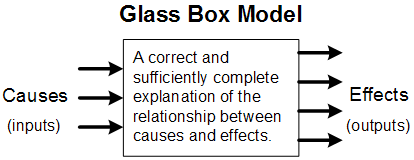 What modern anatomy and biology provided was a glass box model, which allows you to clearly and correctly see why cause and effect occurs. For example, after Newton discovered gravity and the mathematical laws governing the movement of bodies, astronomers had a glass box model of the universe. They could now accurately predict where heavenly bodies would be in the future (the effect) given their present location, speed, and other bodies whose presence affected them (the cause). A glass box model provides a correct and sufficiently complete explanation of the relationship between causes and effects.
The great flaw in a black box model is you're forced to guess what will solve the problem. The result is solutions that work too slowly, partially, or not at all.
By contrast in a glass box model, such as by using laws of behavior, matrix analysis, causal loop diagrams or simulation models, you can analyze why the system works the way it does until that knowledge leads to solution.
The global environmental sustainability problem is so incredibly novel and complex that no one can begin to rationally solve it without basing analysis on a glass box model of the system. Trying instead to solve it with a black box approach guarantees a long, endless road paved with good intentions, hard work, endless failure, and deep frustration.
How are we going to solve the sustainability problem?
By thwinking inside the box.
Once you can see inside the box it's like you're Superwoman. Rather than leaping tall buildings, your x-ray vision enables you to leap to the core of tall problems and how to solve them.
Being able to thwink inside the box by building a model of the problem is how every large scientific problem in history was solved. It's how Newton solved the eternal mystery of what made things move. It's how Darwin solved the mystery of how life came to be. It's how genetic engineering changed plant and animal breeding from a slow art to a lightning fast science.
And it's how you will be able to solve the sustainability problem.
Why We're Here
We're here to help you. Once common good activists start using the same problem solving tools that business and science have long been using, they will be able to make strides so great they will astonish themselves.
While the tools shown above have long been applied to all sorts of difficult technical problems, they have seldom been deeply applied to difficult social problems. Thwink about it. How many activists talk in terms of root causes, process improvement, and understanding the structure of a problem in terms of its key feedback loops? Nearly none. What might they find if they did? Probably the same thing we found, which is why:

Thwink.org exists to help you and your organization learn how to apply these powerful tools to your problems so you can concentrate on systemic solutions. Systemic problems require systemic solutions.
Where to Start
If you want to make the most of your time there are three good places to start:
1. You can click through the slide show at the bottom of each page. Spend some time on each slide to learn the story of how "a new type of thinking" works.
2. Or you can do some learning about the theory behind these incredibly powerful tools. They are the race cars and you are the driver. The easiest place to start is How to Strike at the Root.
3. Or you can start with an off-the-shelf solution that's ready to roll. It's a practical and revolutionary way for you and your organization to become an environmental steward of the planet in record time. It's the Common Property Rights Project.
Or you can do all three.
If enough activists make the transformation the result will be Environmentalism 2.0.


